 Moonleap
The leap chart that learns your baby
See when your baby's growth leaps are coming, what they're learning, and how to play along. Then watch your baby's own rhythm appear.
Download for iPhone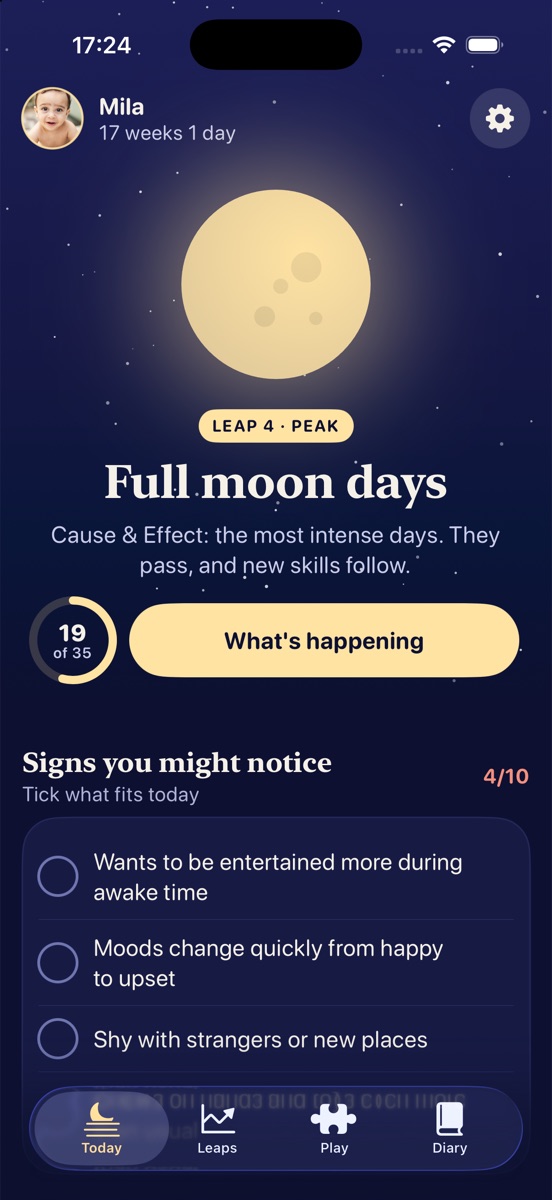
Babies don't read the chart
Leap charts are a helpful map, but parents tell the same two stories again and again.
"The dates were off for us"
Leaps often arrive a week early or late. A chart that only predicts, and never checks, leaves you second-guessing at 3 a.m.
"I had to pay before I saw anything"
Nobody wants to subscribe to an app they've never tried, especially with a newborn and no sleep.
Three taps to your baby's chart
Add the due date
Leaps follow the due date, not the birthday, so premature babies are counted right.
See the moons
Ten leaps to about 18 months. Each one waxes to a full moon at its peak, then wanes into calm.
Play and write it down
Tick the signs, try a game made for this leap, and keep a diary that sorts itself by leap.
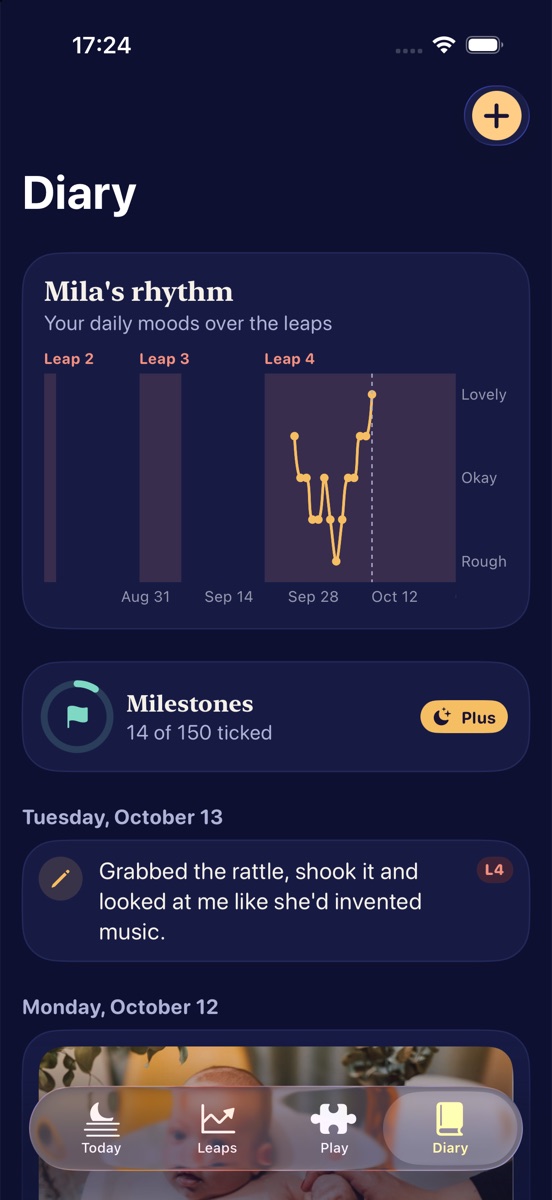
Your baby's own rhythm
A one-tap mood each day, drawn over the leaps. See whether the hard days line up with the chart, and nudge every leap earlier or later if they don't.
Scrub through every leap
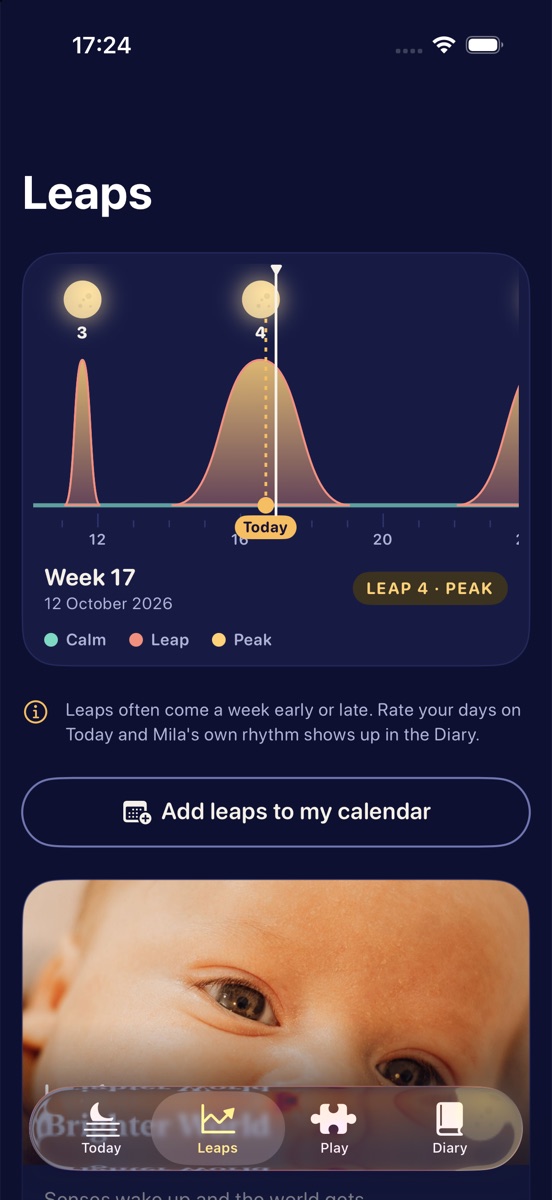
Drag the timeline to any week and see what's coming, with dates. Add all ten leaps to your phone's calendar in one tap.
What to do, not just what to expect
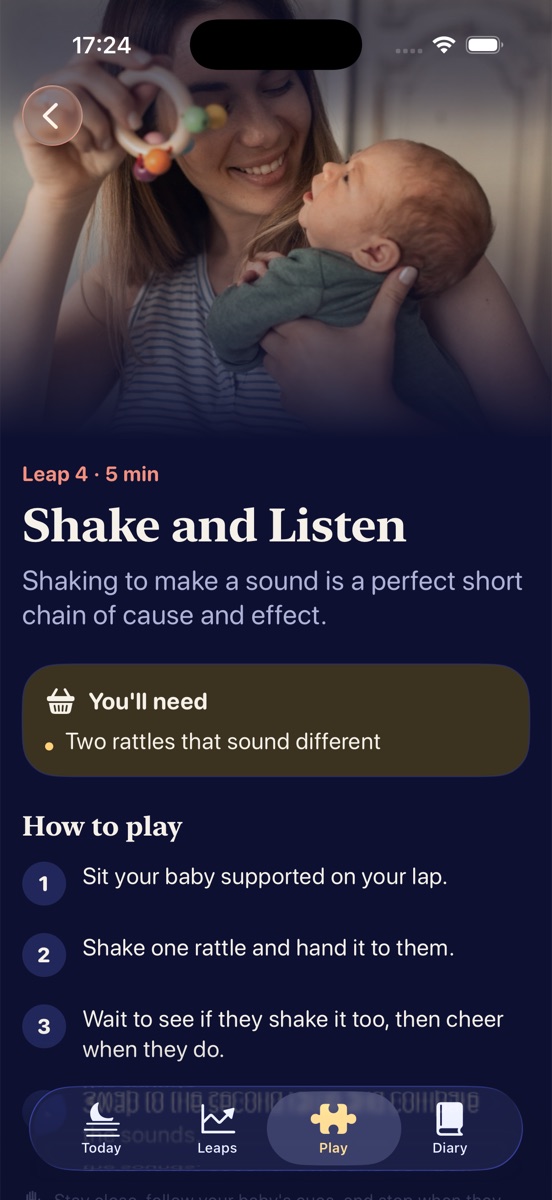
Every leap has games built for the skills it brings, with photos, what you need and simple steps. Mark one played and it lands in your diary.
Free to start. Pay once if you like it.
Leaps 1 and 2 in full, the whole chart, the signs for every leap and your diary are free. Plus unlocks the rest.
Free
- Chart for all ten leaps, with dates
- Signs for every leap
- Leaps 1 and 2 in full
- Diary, photos and daily mood
- Reminders before each leap
Plus, once
- All ten leaps in full
- 80 play ideas
- 150 milestones
- Every baby in the family
- Shared with Family Sharing
Plus, yearly
- Everything in Plus
- 7 days free, reminder before it ends
- Or $3.99 a month
Good to know
What is a developmental leap?
Researchers noticed that many babies go through short, fussy stretches at similar ages, counted from the due date, often followed by new skills. Moonleap maps ten of them over the first 18 months or so. Timing varies by a week or two, and every baby is different.
Why the due date and not the birthday?
Brain development follows the time since conception, so a baby born three weeks early usually reaches each leap three weeks later than their birthday suggests.
Is this medical advice?
No. It's general information to help you understand fussy days. If your baby has a fever, feeds poorly, or cries in a way that worries you, call your doctor.
Do I need an account?
No. Everything stays on your iPhone. There is no sign-up, no tracking and no ads.
Can my partner use it too?
Plus is shared through Apple Family Sharing, so your partner gets it on their iPhone at no extra cost.
Can I cancel?
Yes, in one tap from your iPhone's Settings. We remind you two days before a free trial ends. Or skip subscriptions and pay once.